Link
Defining Links
Links are defined in the links section of each response:
      responses:
        '200':
          description: Created
          content:
            ...
          links:   # <----
            ...
        '400':
          description: Bad request
          content:
            ...
          links:   # <----
            ...
Full Example
openapi: 3.0.0
info:
  version: 0.0.0
  title: Links example
paths:
  /users:
    post:
      summary: Creates a user and returns the user ID
      operationId: createUser
      requestBody:
        required: true
        description: A JSON object that contains the user name and age.
        content:
          application/json:
            schema:
              $ref: '#/components/schemas/User'
      responses:
        '201':
          description: Created
          content:
            application/json:
              schema:
                type: object
                properties:
                  id:
                    type: integer
                    format: int64
                    description: ID of the created user.
          # -----------------------------------------------------
          # Links
          # -----------------------------------------------------
          links:
            GetUserByUserId:   # <---- arbitrary name for the link
              operationId: getUser
              # or
              # operationRef: '#/paths/~1users~1{userId}/get'
              parameters:
                userId: '$response.body#/id'
              description: >
                The `id` value returned in the response can be used as
                the `userId` parameter in `GET /users/{userId}`.
          # -----------------------------------------------------
  /users/{userId}:
    get:
      summary: Gets a user by ID
      operationId: getUser
      parameters:
        - in: path
          name: userId
          required: true
          schema:
            type: integer
            format: int64
      responses:
        '200':
          description: A User object
          content:
            application/json:
              schema:
                $ref: '#/components/schemas/User'
components:
  schemas:
    User:
      type: object
      properties:
        id:
          type: integer
          format: int64
          readOnly: true
        name:
          type: string
operationId
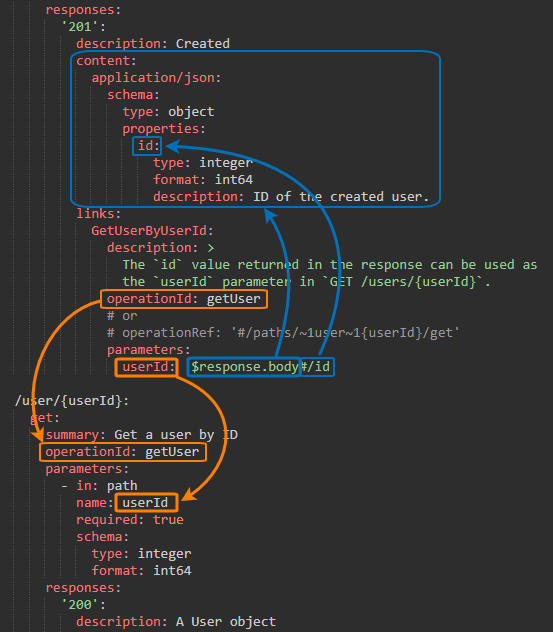
If the target operation has operationId specified, the link can point to this ID – as in the image above. This approach can be used for local links only, because the operationId values are resolved in the scope of the current API specification.
operationRef
operationRef can be used when operationId is not available. operationRef is a reference to the target operation using the JSON Reference syntax – same as used by the $ref keyword. References can be local (within the current API specification):
operationRef: '#/paths/~1users~1{userId}/get'
or external:
operationRef: 'https://anotherapi.com/openapi.yaml#/paths/~1users~1{userId}/get'
operationRef: './operations/getUser.yaml'
Here, the string #/paths/~1users~1{userId}/get actually means #/paths//users/{userId}/get, but the inner slashes / in the path name need to be escaped as ~1 because they are special characters.
#/paths/~1users~1{userId}/get
   │       │               │
   │       │               │
paths:     │               │
  /users/{userId}:         │
    get:  ─────────────────┘
      ...