Parameters
Operations can have parameters passed via URL path (/users/{userId}), query string (/users?role=admin), headers (X-CustomHeader: Value) or cookies (Cookie: debug=0). You can define the parameter data types, format, whether they are required or optional, and other details
- in: see below sections
- name: name of the param.
- description: description about the parameter.
- required: is the parameter requerd "true" or not "false".
- schema: the type and the format of parameter and can add some constraint such as minimux, maximum and default more about Schema
Query Parameters
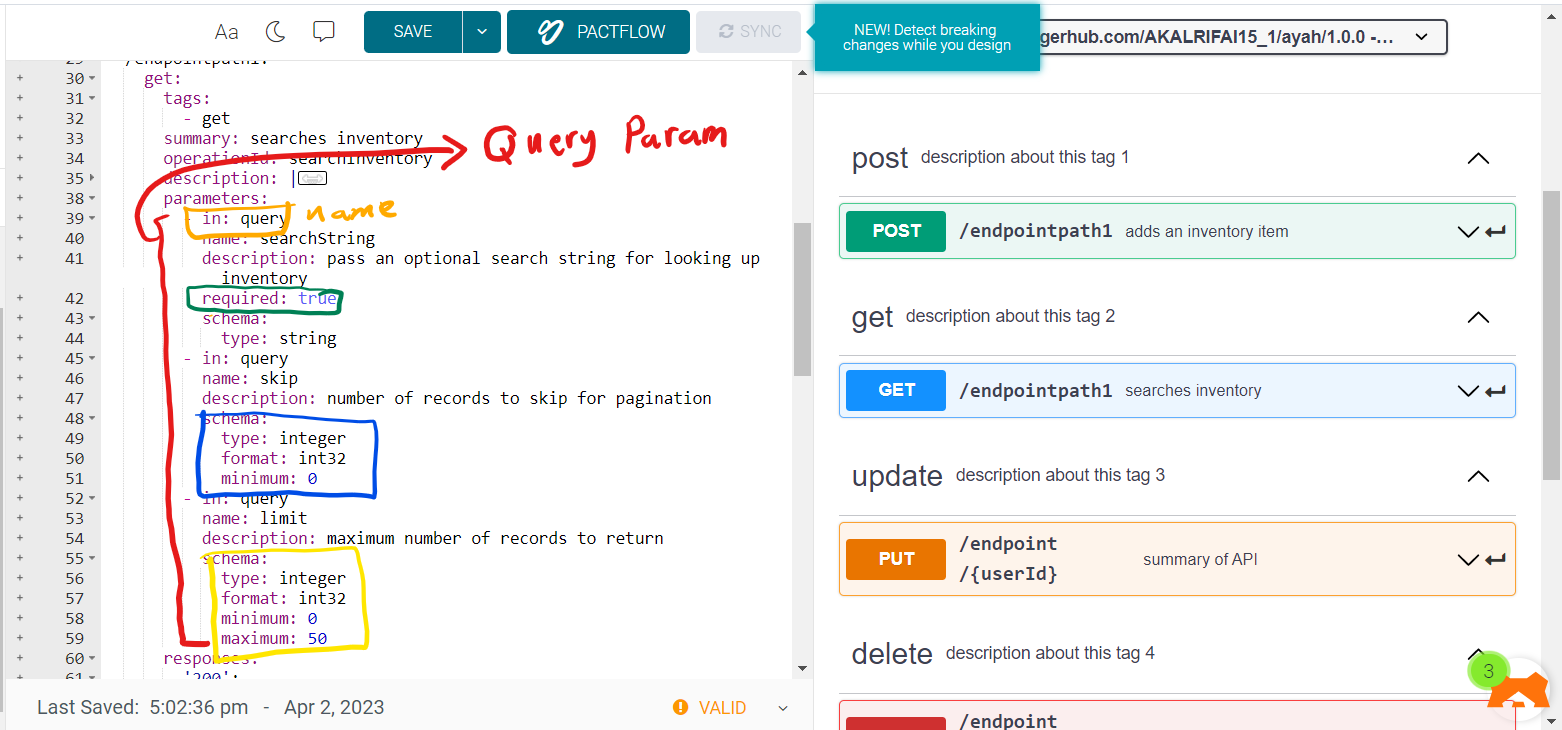
in: the type of parameter "query -> query param" such as ?id=x ?name=xxx&age=x where id, name, age are "in"
 parameters:
        - in: query
          name: searchString
          description: pass an optional search string for looking up inventory
          required: true
          schema:
            type: string
        - in: query
          name: skip
          description: number of records to skip for pagination
          schema:
            type: integer
            format: int32
            minimum: 0
        - in: query
          name: limit
          description: maximum number of records to return
          schema:
            type: integer
            format: int32
            minimum: 0
            maximum: 50
Path Parameters
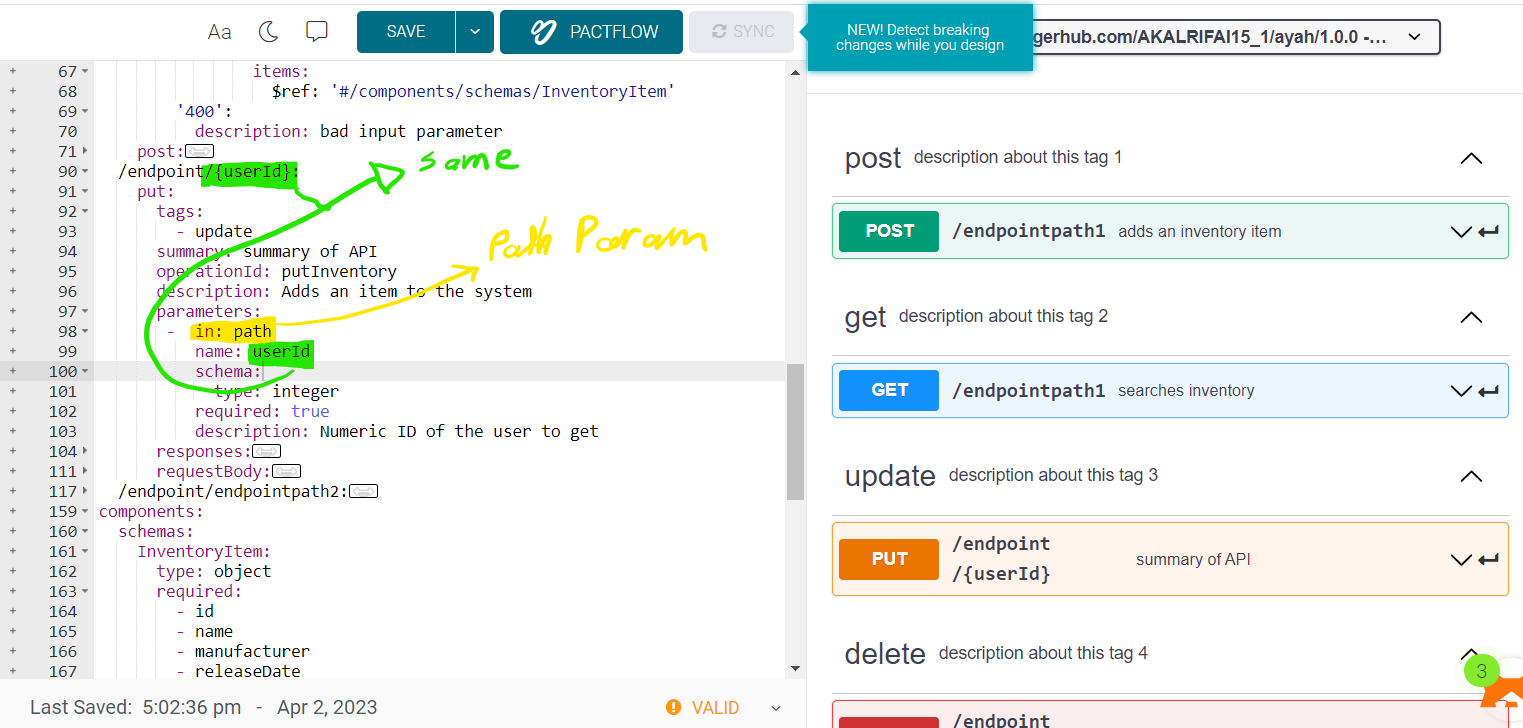
in: the type of parameter "path -> path param" such as /${name}/${id} name and id are path params
/endpoint/{userId}:
    put:
      .
      .
      .
      parameters:
       -  in: path
          name: userId
          schema:
            type: integer
          required: true
          description: Numeric ID of the user to get
Header Parameters
An API call may require that custom headers be sent with an HTTP request. OpenAPI lets you define custom request headers as in: header parameters. For example, suppose, a call to GET /ping requires the X-Request-ID header:
GET /ping HTTP/1.1
Host: example.com
X-Request-ID: 77e1c83b-7bb0-437b-bc50-a7a58e5660ac
Using OpenAPI 3.0, you would define this operation as follows:
paths:
  /ping:
    get:
      summary: Checks if the server is alive
      parameters:
        - in: header
          name: X-Request-ID
          schema:
            type: string
            format: uuid
          required: true
In a similar way, you can define custom response headers. Header parameter can be primitives, arrays and objects. Arrays and objects are serialized using the simple style
Note: Header parameters named Accept, Content-Type and Authorization are not allowed. To describe these headers, use the corresponding OpenAPI keywords
Cookie Parameters
Operations can also pass parameters in the Cookie header, as Cookie: name=value. Multiple cookie parameters are sent in the same header, separated by a semicolon and space.
GET /api/users
Host: example.com
Cookie: debug=0; csrftoken=BUSe35dohU3O1MZvDCUOJ
Use in: cookie to define cookie parameters:
      parameters:
        - in: cookie
          name: debug
          schema:
            type: integer
            enum: [0, 1]
            default: 0
        - in: cookie
          name: csrftoken
          schema:
            type: string